
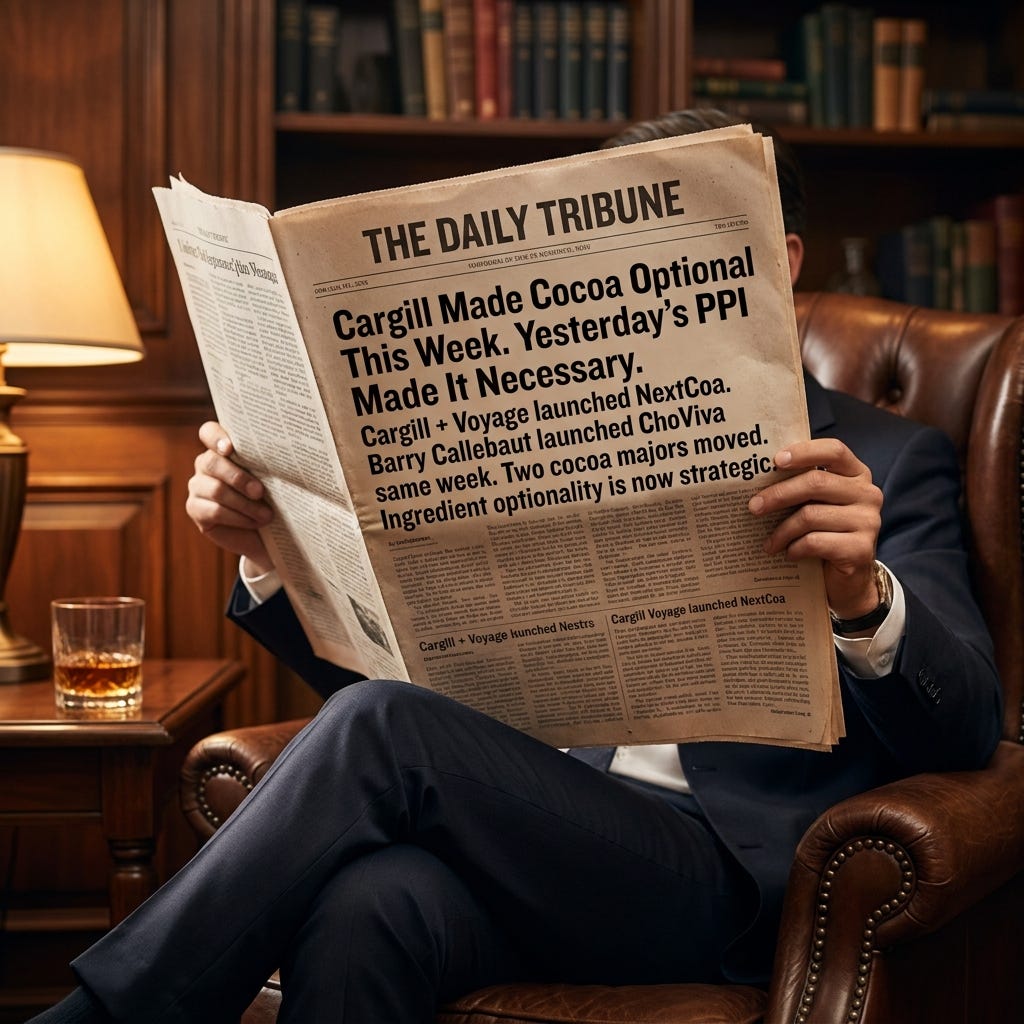
Cargill Made Cocoa Optional This Week. Yesterday's PPI Made It Necessary.
Cargill + Voyage launched NextCoa. Barry Callebaut launched ChoViva same week. Two cocoa majors moved. Ingredient optionality is now strategic.

Cargill and Voyage Foods launched NextCoa in North America this week, starting with the US, with Canada to follow. The product is a cocoa-free confectionery alternative made from grape seeds and plant-based ingredients, formulated to deliver chocolatey-like taste through standard chocolate-making processes. NextCoa is dairy-free, soy-free, peanut-free, tree-nut-free, vegan, Kosher pareve, and Halal suitable. Third-party lifecycle assessment puts the carbon footprint at 67% below conventional chocolate. Cargill is the exclusive global B2B distributor for Voyage Foods under a 2024 commercial partnership, and Voyage opened a 284,000 square foot production facility in Mason, Ohio to support the rollout.
Barry Callebaut, the world’s largest chocolate maker, announced its own cocoa-free alternative the same week, branded ChoViva. Two cocoa-industry majors moved on cocoa alternatives in seven days. That is not a coincidence. That is a category crossing from R&D into commercial reality.
The macro context: cocoa futures peaked at approximately $12,000 per ton in early 2024, settled in the $7,000-$8,000 range through 2025, and remain at 2-3x historical norms. West African supply (60-70% of global cocoa) has been structurally damaged by climate-driven disease, aging tree stock, declining smallholder farmer economics, and child labor regulation enforcement. The supply pressure is not cyclical. The alternative-ingredient response is not optional — it is what the input market has been signaling for two years.
Yesterday’s PPI print quantified what this looks like at the macro level. Wholesale prices up 6% annually, services PPI up 1.2% confirming tariff cost flow-through, real wages negative for the first time since April 2023, Fed pricing 39% probability of a rate hike. The operational thesis I have been arguing for two weeks is that DTC brands need to rebuild the cost structure underneath rather than raise prices to protect margin. Today’s Cargill news is one concrete example of what “rebuild the cost structure” actually looks like for DTC food and CPG operators. The input is no longer fixed. The brands that internalize this earlier compound advantage that brands locked into single-ingredient single-supplier procurement cannot match.
Three DTC Implications
One: Procurement is no longer a back-office function. It is a strategic capability.
DTC food and CPG brands at sub-$50M revenue have historically taken signature ingredient prices as a fixed input. The supplier was the supplier. The price was the price. Procurement was a quarterly contract negotiation, not a strategic conversation. That model worked when input costs moved within normal ranges.
The cocoa situation is what happens when input costs move outside normal ranges and stay there. Brands that have been paying 2-3x historical cocoa cost for the past 24 months have been absorbing the compression at the margin line. Two major suppliers just declared cocoa-free alternatives commercially viable in the same week. The brands that build procurement optionality — existing supplier plus alternative supplier on standby, or partial substitution recipes that can be deployed in 60-90 days — have structurally lower cost volatility than brands locked into single-ingredient single-supplier procurement.
The Coach playbook from May 8 named operational efficiency as one of the five moves that produced Tapestry’s FY guidance raise. Procurement optionality is the food and CPG version of that operational discipline. Brands without the optionality are exposed to the next supply shock without recourse. Brands with the optionality have a lever they can pull when the math turns against them.
Two: R&D and product development cycles need to compress.
A chocolate-bar brand reading the NextCoa news today has a real decision to make. When does an alternative ingredient become credible enough to test in a real product? When does it become credible enough to ship at scale? The brands that wait for category adoption before testing will be 12-18 months behind brands that order samples this week, develop two or three test recipes inside the next quarter, and have a deployable alternative formulation ready before the next cocoa price shock.
This is not a recommendation to immediately switch ingredients. It is a recommendation to build reformulation as a continuous capability rather than a periodic project. Most DTC food and CPG brands run R&D in batches — a new SKU development cycle every six to twelve months, with reformulation work as a special project triggered by complaints, ingredient shortages, or marketing pressure. The brands that compound advantage in an environment of structural input cost volatility treat reformulation as a continuous capability with active testing of alternative inputs across all signature ingredients, not just the one currently in crisis.
The infrastructure is procedural, not technological. Sample-and-test protocols for new ingredients. Documented formulation flexibility ranges for core SKUs. Pre-defined consumer testing methodology that can validate a substitution inside three weeks rather than three months. The capability lives inside the operations team, not the marketing team. Most brands at this revenue band do not have it.
Three: The allergen-restricted and dietary-inclusion segment just expanded.
NextCoa is dairy-free, soy-free, peanut-free, tree-nut-free, vegan, Kosher pareve, and Halal suitable. That is a remarkable set of dietary credentials for a confectionery ingredient. Chocolate-adjacent DTC brands have historically had to make trade-offs between authentic chocolate experience and allergen accommodation. NextCoa makes the trade-off easier to close.
This matters operationally for brands targeting allergen-restricted, dietary-inclusion, or values-aligned (vegan, kosher, halal) consumers. The addressable market for chocolate-adjacent products inside these segments has been bounded by formulation constraints. NextCoa removes some of those constraints. Brands that develop SKUs targeting these segments using NextCoa-style ingredients can offer chocolatey-like indulgence to consumer cohorts that historically had to settle for clearly-inferior chocolate alternatives or skip the category entirely.
The cohort math matters. The vegan consumer base in the US sits around 4-6% of adults but skews younger and higher-income, which is the same skew Coach is capturing in the Gen Z accessible-luxury data from May 8. The dietary-inclusion market (kosher, halal, allergen-restricted) layered together represents an addressable population in the tens of millions in the US alone. DTC brands building product lines that serve this segment with chocolatey-like indulgence are operating in a less crowded competitive set than mass-market chocolate competitors.
The Broader Pattern Beyond Cocoa
The cocoa situation is the canonical example. It is not the only example. Every signature ingredient with structural supply pressure is on a similar trajectory.
Eggs ran through avian flu price spikes in 2023-2024 that hit historic highs. Egg prices in the April 2026 PPI report dropped 49.7% month over month, suggesting moderation, but the period of stress produced commercial alternative-egg products (Just Egg, plant-based eggs in commercial baking applications) that did not exist at meaningful scale five years ago. Brands using alternative eggs in baking formulations now have an option that was R&D-stage in 2020.
Vanilla has been in structural supply crisis from Madagascar for nearly a decade. Real vanilla extract trades at $200-$400 per kilogram depending on grade. Alternative vanilla (synthetic vanillin, biosynthetic vanilla from precision fermentation) has been gradually professionalizing as a commercial input.
Coffee hit historic highs in 2024-2025 from Brazilian climate damage. Alternative coffee categories (chicory-based, mushroom-based, lab-grown molecular coffee) are emerging.
Olive oil saw Spanish and Italian production crash 50% in 2023-2024 from drought, with prices doubling before starting to normalize. Alternative oil blends and high-oleic sunflower oil have been substituting in food service applications.
The pattern is consistent. Climate pressure plus geopolitical pressure plus regulatory pressure plus tariff regime equals structural input cost volatility for signature ingredients. The strategic capability for DTC food and CPG brands is treating ingredient flexibility as a competitive advantage rather than as a defensive necessity. Brands that build the capability across multiple ingredients before the next crisis hits have option value that compounds over years.
The Honest Skepticism
Alternative-ingredient sensory quality varies meaningfully across applications. NextCoa is described as “chocolatey-like” rather than “chocolate-identical.” Brands considering substitution need to run real consumer testing inside their specific product applications. The 67% carbon footprint reduction is third-party verified to ISO standards. The taste claim is sensorially evaluated by the manufacturer. The two are different categories of evidence.
Consumer acceptance is not guaranteed. Some consumer cohorts will reject “chocolate alternative” framing on principle, even when blind testing shows favorable sensory outcomes. The marketing and positioning work matters as much as the ingredient choice. Brands that switch silently without addressing the framing question will hit consumer-side resistance regardless of product quality.
B2B pricing for NextCoa is not disclosed. The pricing stability and cost-effectiveness claims from Cargill are likely directionally true given the upstream pressure on cocoa, but the actual cost savings for a brand running specific formulations are situational. Run the math on actual replacement scenarios, not on the headline framing.
Vendor-driven sustainability claims need vendor-skepticism applied. Cargill has commercial interest in growing alternative-ingredient categories. Voyage Foods has commercial interest in NextCoa adoption. The 67% carbon footprint number is real and third-party verified, but it sits inside a marketing narrative that is also designed to drive adoption. Same conflict-of-interest pattern as the IBM, BCG, Walr, Mixpanel, Foundry, Immerss, NRF, and Entrepreneur pieces from earlier weeks. Read the data, weight the framing, apply your own interpretation.
“Drop-in replacement” typically requires reformulation work. The press release framing implies plug-and-play substitution. The operational reality usually involves recipe iteration, processing adjustment, packaging update, and shelf-life revalidation. Plan for a 60-120 day substitution cycle, not a same-week swap.
What To Do
Three things this month, sized to operator scale.
First, audit your top three signature ingredient supply exposures. Which ingredients sit at the core of your bestselling SKUs? What is the current price relative to two-year and five-year historical ranges? What is the supply concentration (single supplier, single geography, single processing channel)? Identify the highest-exposure ingredient and put it on a 90-day procurement-optionality build plan. Even if the alternative is “second supplier on standby” rather than “ingredient substitution,” the optionality has option value.
Second, if you are in a chocolate-adjacent category, order NextCoa or ChoViva samples this week. Run sensory testing inside your specific product applications. The cost of testing is bounded. The cost of waiting until the next cocoa price shock to start testing is unbounded. Brands that have a deployable alternative formulation by Q4 2026 are positioned for whatever the next cocoa cycle does. Brands that wait until they need it are 12-18 months too late.
Third, build the reformulation muscle as continuous capability. Designate one person on the operations team as the lead on alternative-ingredient testing. Run two or three samples per quarter against existing signature SKUs, even when the existing formulation is performing fine. The goal is not to switch every time something tests well. The goal is to have option value when the input market turns against you. The brands that compound advantage in the next 24 months are the brands that built this capability while it was elective rather than emergency.
The counterintuitive move: while every DTC food and CPG operator is reading the cocoa news as “interesting, not relevant to my brand right now,” the brands that compound advantage are reading it as “the input market has structurally changed and ingredient flexibility is now a strategic capability rather than a defensive necessity.” The brands that internalize this earlier build option value that compounds. The brands that internalize it after the next supply shock are paying for the same lesson at much higher cost.
What I’m Watching
Whether NextCoa and ChoViva reach commercial scale inside major DTC chocolate-adjacent brands by end of 2026 — which would mark the category crossing from “available” to “adopted.” Whether other cocoa-industry players (Olam, Mondelez, Mars) announce alternatives over the next 90 days, which would confirm structural category shift rather than two-supplier outlier. Whether cocoa futures moderate or escalate through Q3, with implications for the speed of alternative adoption. Whether similar alternative-ingredient announcements emerge in vanilla, eggs, coffee, or olive oil over the next 90-180 days, completing the pattern across signature food inputs. Whether DTC food brands at the $5M-$50M revenue band publicly disclose alternative-ingredient adoption in marketing or product narratives, which would tell us how consumer acceptance is sorting out.
The PPI confirmation yesterday and the cocoa-alternative news this week are pointing at the same operational reality. Input costs are structurally higher and more volatile than they were 24 months ago. The brands that build cost-structure optionality have a lever that brands operating on fixed-input assumptions do not have. The Coach playbook from May 8 named accessible-luxury positioning as the strategic answer for consumer-facing positioning. The Cargill news today names ingredient optionality as the strategic answer for supply-side procurement. The two answers are the same answer at different points in the value chain. The discipline is the same. The payoff is the same. The brands that build it win the next 18 months.
That is the play.
Sources:
https://www.fooddive.com/news/cargill-voyage-foods-coca-free-chocolate-alternative-nextcoa/820275/
https://www.businesswire.com/news/home/20260512386424/en/Cargill-and-Voyage-Foods-to-Bring-NextCoa-Cocoa-free-Confectionery-Alternatives-to-North-America
https://www.foodbusinessnews.net/articles/30305-cargill-launches-cocoa-alternative-with-voyage-foods
John Parvu is a Senior Media Buyer and Creative Strategist at eCom Ads. He works with DTC brands on profit-first paid media across Meta and Google.